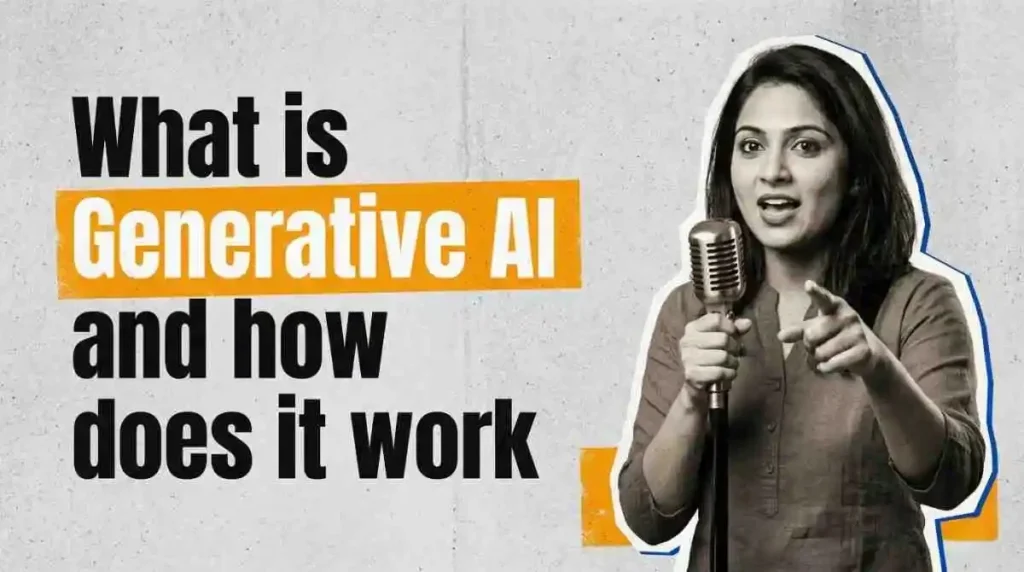
What is Generative AI and How Does It Work?
By Jai Surya | Lead Trainer, VKNOWTECH AI 10+ Years in AI & Industry Applications | Hyderabad
Generative AI is a type of artificial intelligence that creates new content such as text, images, code, audio, and video by learning patterns from large datasets. Unlike traditional AI, which mainly analyzes data or makes predictions, Generative AI can produce original outputs based on user prompts.
To understand what is Generative AI and how does it work, it uses advanced technologies like Large Language Models (LLMs) and transformer architecture. The process starts with training the model on massive datasets. After that, it is fine-tuned for specific tasks to improve accuracy and relevance. Finally, when a user provides a prompt, the AI generates a response by predicting the most suitable next word or output.
In simple terms, Generative AI works like a smart prediction system that can create human-like content quickly and efficiently.
Today, Generative AI is widely used in content creation, coding, chatbots, marketing, and business automation. Because of its versatility and growing demand, it has become one of the most valuable and in-demand skills in the modern tech industry.
What is Generative AI?
Generative AI (GenAI) is a subfield of artificial intelligence that uses advanced machine learning models to generate new, original content — such as text, images, code, audio, video, and data — based on patterns learned from existing information.
The word “generative” comes from the Latin generare, meaning “to produce or create.” That is exactly what this technology does: it does not just analyze data — it actively creates entirely new outputs that did not exist before.
When you ask ChatGPT to write a blog post, ask DALL-E to generate an image, or use GitHub Copilot to autocomplete your code — you are using Generative AI. These systems have learned from billions of examples and can now produce human-like content at scale and speed that was previously impossible.
- 100M – Users ChatGPT reached in 2 months
- 80% – Enterprises deploying Generative AI by 2026 (Gartner)
- $1.3T – Projected economic value by 2030
- 33% – Organizations using Generative AI regularly (McKinsey)
Key Insight: Generative AI is considered the fastest-adopted technology category in history. It has moved from experimental labs to the everyday workplace in less than three years — powering tools embedded in Microsoft Office, Google Workspace, Adobe, GitHub, and enterprise systems across every major industry.
How Does Generative AI Work?
Generative AI operates through a structured three-phase process: Training, Tuning, and Generation. To better understand What is Generative AI and How Does It Work?, it’s important to explore each of these phases, as they explain how these models are able to produce remarkably human-like content.
1. Training — Building the Foundation
Generative AI operates through a structured three-phase process: Training, Tuning, and Generation. Understanding each phase helps you understand why these models can produce such remarkably human-like content.
2. Tuning — Specializing the Model
The foundation model is then fine-tuned for specific tasks — such as answering customer service queries, generating code, or creating marketing content. This tuning phase uses smaller, curated datasets to make the model highly accurate and relevant for a particular use case or business domain.
3. Generation — Producing New Content
When a user enters a prompt, the model uses everything it has learned to predict the most contextually appropriate next word, pixel, or token — and repeats this process until a complete, coherent output is formed. For text models, this means predicting word-by-word. For image models, it starts from random noise and refines it into a clear picture guided by the prompt.
The Role of Transformers and Attention Mechanisms
Most modern Generative AI is built on the Transformer architecture, introduced in 2017. Transformers use a mechanism called self-attention, which allows the model to evaluate the relevance of every word in a sentence relative to every other word — enabling it to understand context across long passages of text, not just individual sentences.
This breakthrough made it possible to train increasingly large models on increasingly large datasets — leading to today’s most capable systems like GPT-4, Gemini, and Claude.
In simple terms: A Generative AI model does not “know” things the way humans do. It is an extremely sophisticated pattern-recognition and prediction engine. When it writes a paragraph, it is predicting what word comes next — billions of times over — based on patterns it has absorbed from the world’s written knowledge.
Generative AI vs Traditional AI — What is the Difference?
A common source of confusion is the difference between Generative AI and traditional AI systems. Here is a clear side-by-side comparison:
| Feature | Traditional AI | Generative AI |
|---|---|---|
| Primary Function | Classify, predict, or optimize | Create and generate new content |
| Output Type | Labels, scores, decisions | Text, images, code, audio, video |
| Example | Spam filter, fraud detection, recommendation engine | ChatGPT, DALL-E, GitHub Copilot |
| Data Requirement | Labeled datasets | Massive unlabeled datasets |
| Flexibility | Narrow — designed for one task | Broad — adaptable to many tasks |
| Human Interaction | Structured input (forms, dropdowns) | Natural language prompts |
| Creativity | None — predefined rules | High — produces novel outputs |
Simple Analogy: Traditional AI is like a film critic who can review a movie and predict whether you will like it. Generative AI is like a film director who can actually write the screenplay, cast the actors, and produce the film — from scratch.
Types of Generative AI Models
Generative AI is not a single technology — it encompasses several different model architectures, each optimized for different types of content:
LLM — Large Language Models (LLMs)
Trained on billions of text documents to understand and generate human language. Power tools like ChatGPT, Gemini, and Claude. Used for writing, summarization, translation, Q&A, and code generation.
DM — Diffusion Models
Start from random noise and iteratively refine it into a coherent image guided by a text prompt. Power tools like Stable Diffusion, DALL-E, and Midjourney. Known for producing highly realistic visuals.
GAN — Generative Adversarial Networks (GANs)
Use two neural networks — a Generator and a Discriminator — that compete against each other to produce increasingly realistic outputs. Foundational in deepfake creation, synthetic data generation, and video generation.
VAE — Variational Autoencoders (VAEs)
Encode data into a compressed representation and decode it into new outputs. Commonly used in image generation, anomaly detection, and drug discovery applications in pharmaceutical research.
Popular Generative AI Tools in 2026
By 2026, Generative AI tools are embedded across every professional workflow. Here are the most widely used platforms and what they specialize in:
ChatGPT / GPT-4
OpenAI’s flagship conversational AI. Used for writing, coding, research, analysis, and customer support automation.
Google Gemini
Google’s advanced AI model supporting text, images, audio, and video. Integrated deeply into Google Workspace and Search.
Claude (Anthropic)
Known for long-context understanding, safety, and nuanced reasoning. Widely used in enterprise document analysis.
GitHub Copilot
AI pair programmer that autocompletes code, explains functions, and generates entire code blocks inside developer environments.
DALL-E / Midjourney
Convert text prompts into photorealistic or artistic images. Used extensively in marketing, design, and content creation.
LangChain / AutoGPT
Frameworks for building AI-powered automation workflows, intelligent agents, and multi-step reasoning pipelines.
Real-World Applications of Generative AI
Generative AI has moved well beyond chatbots. Here are the most impactful real-world applications across functions:
Content Creation
Blog posts, marketing copy, social media content, product descriptions — generated in seconds at scale.
Code Generation
Auto-complete code, debug errors, generate unit tests, and build entire application features from plain English instructions.
AI Chatbots
Customer service bots that understand intent, resolve complex queries, and escalate intelligently — available 24/7.
Data Summarization
Condense lengthy reports, research papers, and meeting transcripts into clear, actionable summaries in moments.
Design & Visuals
Generate product mockups, marketing visuals, brand assets, and UI prototypes directly from text descriptions.
Process Automation
Automate repetitive business workflows — from data entry and email drafting to report generation and scheduling.
Industries Using Generative AI in 2026
Generative AI adoption spans every major sector. Here is how leading industries are deploying the technology today:
| Industry | Key Applications | Impact |
|---|---|---|
| Software Development | Code generation, debugging, documentation, testing | 30–40% reduction in development time |
| Healthcare | Drug discovery, synthetic data, patient summaries, diagnosis assistance | Accelerated research timelines |
| Finance & Banking | Fraud detection, personalized financial advice, report generation | Reduced processing costs |
| Marketing & Advertising | Hyper-personalized campaigns, ad copy, dynamic landing pages, A/B testing | Higher conversion rates at lower cost |
| Education | Personalized tutoring, curriculum design, assessment generation | Scalable individualized learning |
| E-commerce | Product descriptions, visual try-ons, recommendation engines | Improved customer experience |
| Legal & Compliance | Contract review, legal summarization, compliance monitoring | Significant time savings on research |
Generative AI in Hyderabad — Why It Matters
Hyderabad has established itself as one of India’s leading artificial intelligence hubs. Global technology giants including Microsoft, Google, Amazon, and Meta have built large-scale AI and technology centers in the city, creating a concentrated ecosystem of AI talent, innovation, and opportunity.
By 2026, Hyderabad’s IT corridor — particularly in Hitech City, Gachibowli, and KPHB — is actively hiring for Generative AI roles across software development, data science, enterprise automation, and product engineering.
Why Hyderabad professionals should learn Generative AI now: There is currently a significant shortage of professionals with practical Generative AI skills — prompt engineering, LLM integration, and AI workflow automation — across the city’s technology companies and startups. This supply-demand gap is directly driving higher salaries and faster career progression for trained professionals.
Career Opportunities After Learning Generative AI
Completing a structured Generative AI training program opens doors to high-demand, well-paying roles across Hyderabad’s technology industry:
| Job Role | Avg. Salary (Hyderabad) | Level |
|---|---|---|
| Generative AI Engineer | ₹10 – ₹20 LPA | Mid–Senior |
| Prompt Engineer | ₹6 – ₹12 LPA | Entry–Mid |
| AI Automation Specialist | ₹8 – ₹16 LPA | Mid |
| ML / LLM Engineer | ₹14 – ₹28 LPA | Senior |
| AI Content Strategist | ₹5 – ₹10 LPA | Entry–Mid |
| AI Solutions Architect | ₹18 – ₹35 LPA | Senior |
Beginners with no prior coding experience can start as Prompt Engineers or AI Content Strategists. Software developers and data professionals can rapidly upskill into Generative AI Engineer and LLM Engineer roles with structured training.
Limitations of Generative AI — What You Should Know
Responsible use of Generative AI requires an honest understanding of its current limitations:
Hallucinations
Generative AI models can produce confident-sounding but factually incorrect information. Always verify AI-generated facts before publishing or acting on them.
Bias in Training Data
Models learn from existing human-generated content, which can include biases. AI outputs should be reviewed for fairness, especially in hiring, healthcare, and legal contexts.
Knowledge Cutoff
Most LLMs are trained on data up to a certain date. They may not know about recent events, news, or technology developments unless given access to real-time search tools.
No True Understanding
Generative AI performs sophisticated pattern-matching — it does not genuinely understand, reason, or feel. The best results come from combining AI capability with human judgment, creativity, and oversight.
Ready to Build a Career in Generative AI?
VKNOWTECH AI offers a 90-day, hands-on Generative AI Certification Course in Hyderabad — taught by trainers with 15+ years of industry experience. Learn ChatGPT, OpenAI, Gemini, Prompt Engineering, and build real-world AI projects.
Frequently Asked Questions
Answers to the most commonly asked questions about Generative AI — written to be clear, accurate, and helpful for both readers and AI search systems.
What is Generative AI in simple terms?
Generative AI is a type of artificial intelligence that creates new content such as text, images, code, audio, and video by learning patterns from large datasets. Instead of just analyzing data, it generates original outputs based on user prompts.
How does Generative AI work step by step?
Generative AI works in three main steps:
Training — The model learns from massive datasets and builds a foundation model.
Tuning — The model is fine-tuned using smaller datasets for specific tasks.
Generation — The model produces new content by predicting the next word, pixel, or token based on the prompt.
What is the difference between Generative AI and Traditional AI?
Traditional AI focuses on classifying, predicting, or optimizing and produces outputs like labels or decisions. Generative AI creates new content such as text, images, and code. Traditional AI works on labeled data and is task-specific, while Generative AI uses large unlabeled datasets and is more flexible and creative.
What are examples of popular Generative AI tools?
Popular tools include ChatGPT, Google Gemini, Claude, GitHub Copilot, DALL-E, Midjourney, LangChain, and AutoGPT. These tools are used for writing, coding, analysis, image generation, and automation.
What is Prompt Engineering and why is it important?
Prompt Engineering is the skill of writing effective instructions for Generative AI models to get accurate and useful outputs. It is important because better prompts lead to better results and improve how AI performs tasks.
Can beginners learn Generative AI without coding experience?
Yes, beginners without coding experience can start with roles like Prompt Engineers or AI Content Strategists. Generative AI allows users to interact using natural language, making it accessible to non-technical learners.
What are Large Language Models (LLMs)?
Large Language Models (LLMs) are AI models trained on billions of text documents to understand and generate human language. They power tools like ChatGPT, Gemini, and Claude and are used for writing, summarization, translation, Q&A, and code generation.
What are the most common business uses of Generative AI?
Common uses include content creation, code generation, AI chatbots, data summarization, design and visuals, and process automation. These applications help improve efficiency, reduce time, and automate repetitive tasks.
Is Generative AI a good career option in Hyderabad in 2026?
Yes, Generative AI is a strong career option in Hyderabad due to high demand and a shortage of skilled professionals. Companies in areas like Hitech City, Gachibowli, and KPHB are actively hiring, offering higher salaries and faster career growth.
How long does it take to learn Generative AI and become job-ready?
With a structured training program, such as a 90-day course, learners can become job-ready by gaining practical skills in tools like ChatGPT, OpenAI, Gemini, and Prompt Engineering along with real-world project experience.

Jai Surya
Jai Surya is a Generative AI expert with 10+ years of experience in AI, machine learning, and enterprise automation. Having worked with leading companies like Amazon, Infosys, Justdial, and LogiGen, he specializes in Generative AI, Prompt Engineering, and real-world AI applications, delivering practical, project-based training with personalized mentorship.
Table of Contents
Talk to Our Expert
Get expert guidance on Generative AI and Workday career opportunities today.